
About Lexile and Quantile Norms
Lexile® and Quantile® measures tell you a student's current ability level, but a measure on its own doesn't reveal how that performance compares to other students. Norms close this gap by showing how a student's performance compares with other students using the same scale, giving educators, administrators, and families the context they need to make better-informed decisions.
Norms are drawn from a large, geographically diverse sample of students in kindergarten through Grade 12 and are reported by grade and testing season (fall, winter, and spring). They help answer where a student stands relative to peers — not whether an assessment measure itself has changed.
The sections below describe common ways partners leverage Lexile and Quantile norms to enhance offerings and support end users.
1. Understand Student Performance in Context
A Lexile or Quantile measure tells you a student's current ability level, but norms help answer:
- How does this student's measure compare to other students in the same grade?
- Is the student performing above, near, or below typical performance for their grade?
- Where does the student fall within the broader distribution of learners?
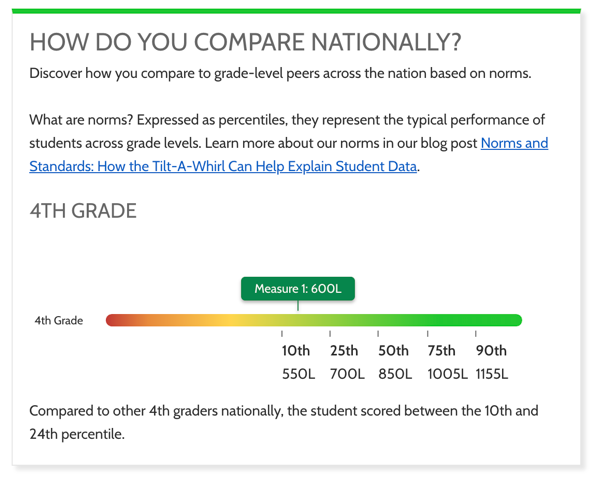
For example, a Grade 5 student with a 750L measure can be interpreted more meaningfully when compared to the typical range of Grade 5 students.
The following example shows one way norms can be presented within a partner product or service:
2. Identify Students Who May Need Additional Support or Enrichment
Norms can help educators identify students whose performance is significantly different from grade-level peers. Uses may include:
- Identifying students who may benefit from additional instructional support
- Recognizing students who may need enrichment or additional challenge
- Grouping students for instructional planning
3. Support Instructional Planning
Norms provide a reference point that helps educators determine whether instructional materials and activities are appropriately matched to student ability. For example:
- Selecting appropriately challenging reading materials based on a student's Lexile measure
- Understanding whether math concepts and skills are aligned to a student's Quantile measure
- Planning differentiated instruction
4. Monitor Progress Over Time
When used alongside repeated measures, norms can help provide context for whether student progress is consistent with expectations. Norms can help answer:
- Has the student maintained their relative position compared with peers?
- Is the student's growth keeping pace with typical growth patterns?
For projected growth targets, longitudinal growth models such as Growth Planner are better suited.
5. Support School, District, or Program-Level Analysis
Norms can be used to understand performance patterns across groups of students. Examples:
- Comparing student performance distributions across grades
- Identifying groups that may need additional resources
- Evaluating instructional initiatives at a high level
6. Communicate Progress with Families
Norms can help explain student performance in a way that is easier for families to understand. Instead of only sharing:
"Your child has a Lexile measure of 650L."
Educators can provide context:
"Your child's Lexile measure is compared with other students in the same grade to help us understand their current reading ability and support next steps."
Important Distinction
- Lexile and Quantile measures — Where is the student today?
- Norms — How does the student's current performance compare with peers?
- Growth Planner — Where is the student projected to be by the end of Grade 12? See the Growth Planner API for more information.